
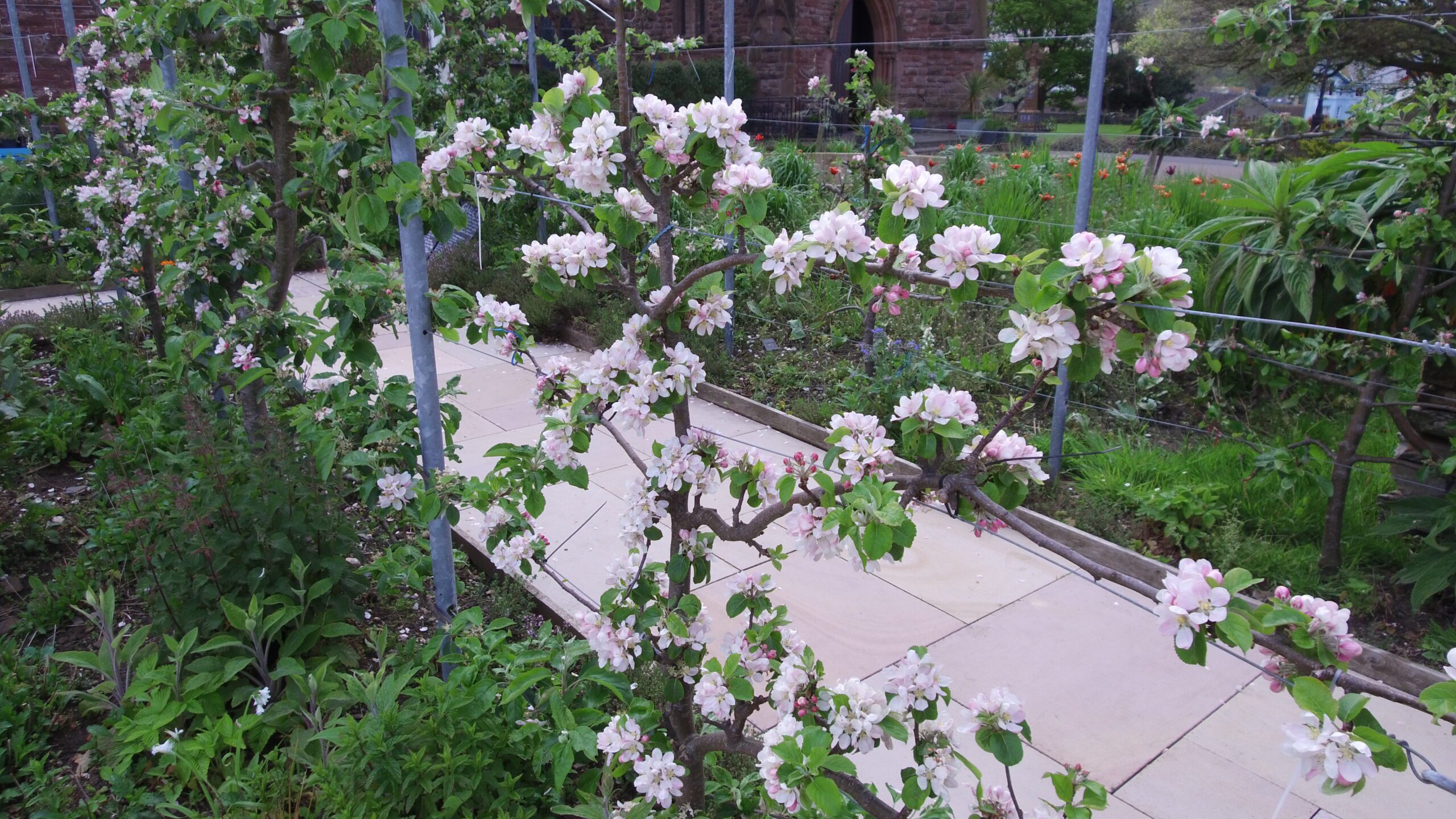
The Abbey Garden – 13th century
The History
The Celtic Church, after the Council of Whitby (664), became increasingly subject to the Latin world. This was the age of the great European monastic orders with their routine of study and labour interspersed with prayer eight times a day. The most important houses on the Island were Rushen Abbey and the Douglas Priory, which were both Cistercian communities, the former for men the latter for women. ‘The Chronicles of the Kings of Man and the Isles’, the first history of the Island, was written in Latin by the monks of Rushen during this period.
The Design
Labyrinths became are a feature of the period with the one at Chartres in France being best known and created about 1200. There is no historic evidence for labyrinths existing in the Isle of Man but the one here represents the influences coming from continental Europe. It has been constructed of contrasting stone imported from Bali. Marked on the labyrinth are the names of the religious houses having property on the Isle of Man including Rushen Abbey, Douglas Priory, Rievaulx Abbey Yorkshire, Whithorn Priory Galloway, Furness Abbey Cumbria, Bangor Abbey Ulster, Sabal Abbey Ulster and St Bees Priory in Cumbria. Around the labyrinth is an apple tunnel which sits on the same size footprint as the cloister at Rushen Abbey.
The angular elements of the garden around the labyrinth are filled with plants used by the monks in their different roles: the Kitchener who looked after the meals, the Chamberlain who cared for the house, the Sacristan who cared for the Abbey church and the Infirmarian who cared for the sick. The Cistercians were great sheep farmers and the unique breed of sheep on the Island is the Loaghtan.
Today
While there are no longer monasteries on the Isle of Man, the Church of England still does have monasteries, for example Mucknell Abbey in Worcestershire. The Cathedral here continues the practice of regular daily prayer with the key times being morning and evening prayer, and we encourage our congregation to make use of a Rule of Life based on the Benedictine monastic tradition. Three times a day you will hear the Angelus bell as a call to prayer.