
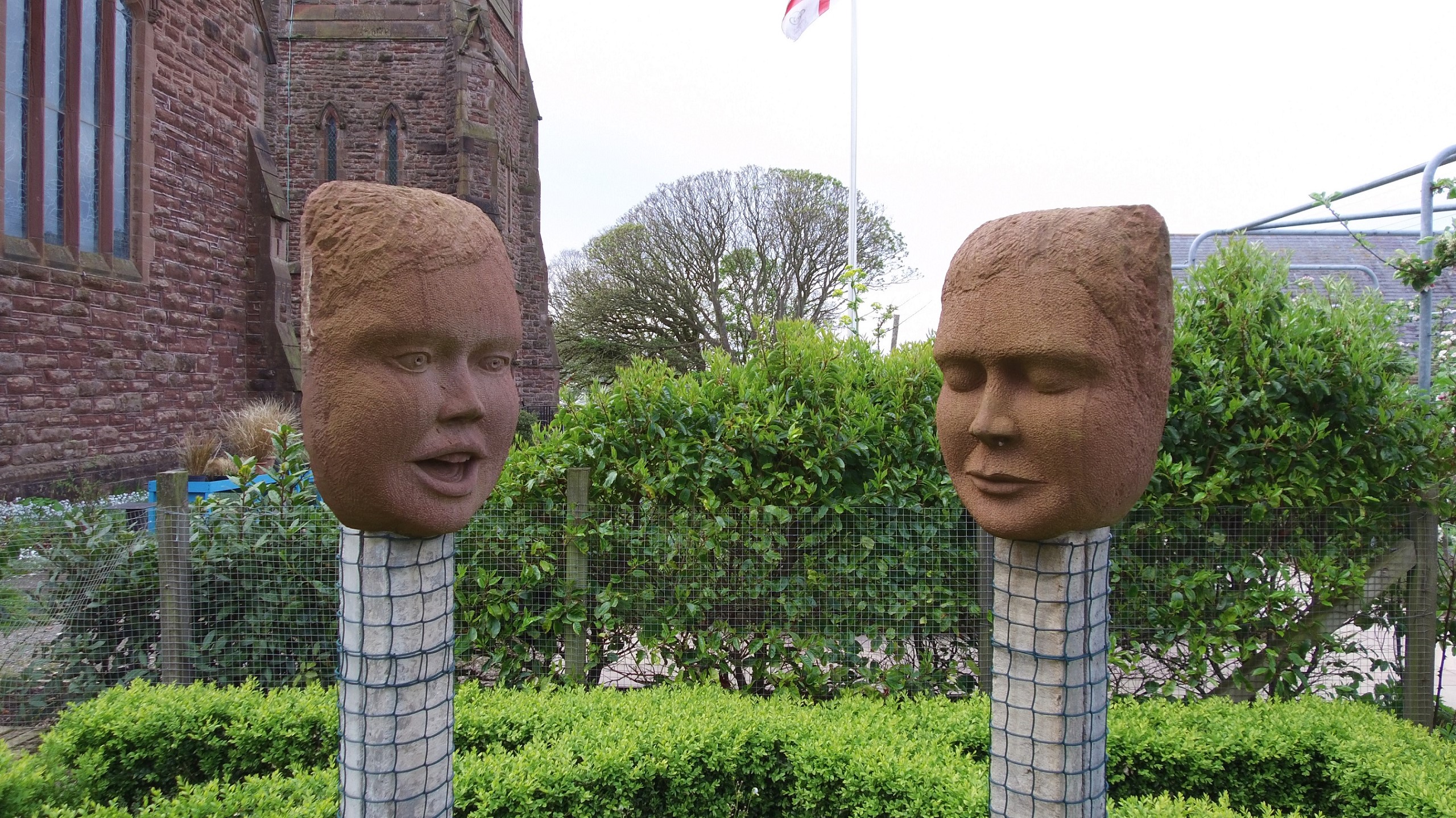
The Bishops’ Garden – 17th century
The History
The Island became caught up with the English Civil War, which resulted in the execution of the Lord of Man, James Stanley, 7th Earl of Derby at Bolton in 1651, and after the Restoration the execution of the Manx patriot Illiam Dhône in 1663. The Restoration brought the reinstatement of the Diocese of Sodor and Man in 1661 with three Bishops making their mark in education: Isaac Barrow, Baptist Levinz and Thomas Wilson.
The Design
The landscape draws its inspiration from the gardens at Bishopscourt in Kirk Michael as sketched by Daniel King of Chester during the Civil War period. Bishopscourt was the home of the Bishops of Sodor and Man from the 13th century until the late 20th century. The garden here, though, is on a much-reduced scale and has brick paths dissecting the beds of a formal knot garden of box. The sculpture in the garden celebrates the value of universal education on the Isle of Man which had its tentative beginnings during this period. Education is represented by two heads of the same child, the one representing lack of insight and knowledge (with eyes down and mouth closed) and the other representing the wonder of education (with eyes and mouth open in wonder). The sculptures have been carved by Pete Yarwood.
Today
The sale of Bishopscourt in 1980 had a number of consequences for our Island Church. The Bishop’s chapel of St Nicholas at Bishopscourt had acted as the pro-cathedral for about 200 years. The sale meant that a new Cathedral had to be found. The Island’s churches voted for the parish church here in Peel, which fortuitously, a hundred years earlier, was built in the hope that it would one day become the Cathedral.