
The Manx Garden – 18th Century
The History
The Reformation did not give the Island’s Church a liturgy in its own language, Manx Gaelic, as the traditional Latin was exchanged for English. However, the eighteenth century saw serious attempts to engage with the Manx language. Bishop Hildesley oversaw the translation of the Prayer Book in 1765 and the Bible in 1773. This helped save the Manx language, laying the foundation for its re-birth in 20th century.
The Design
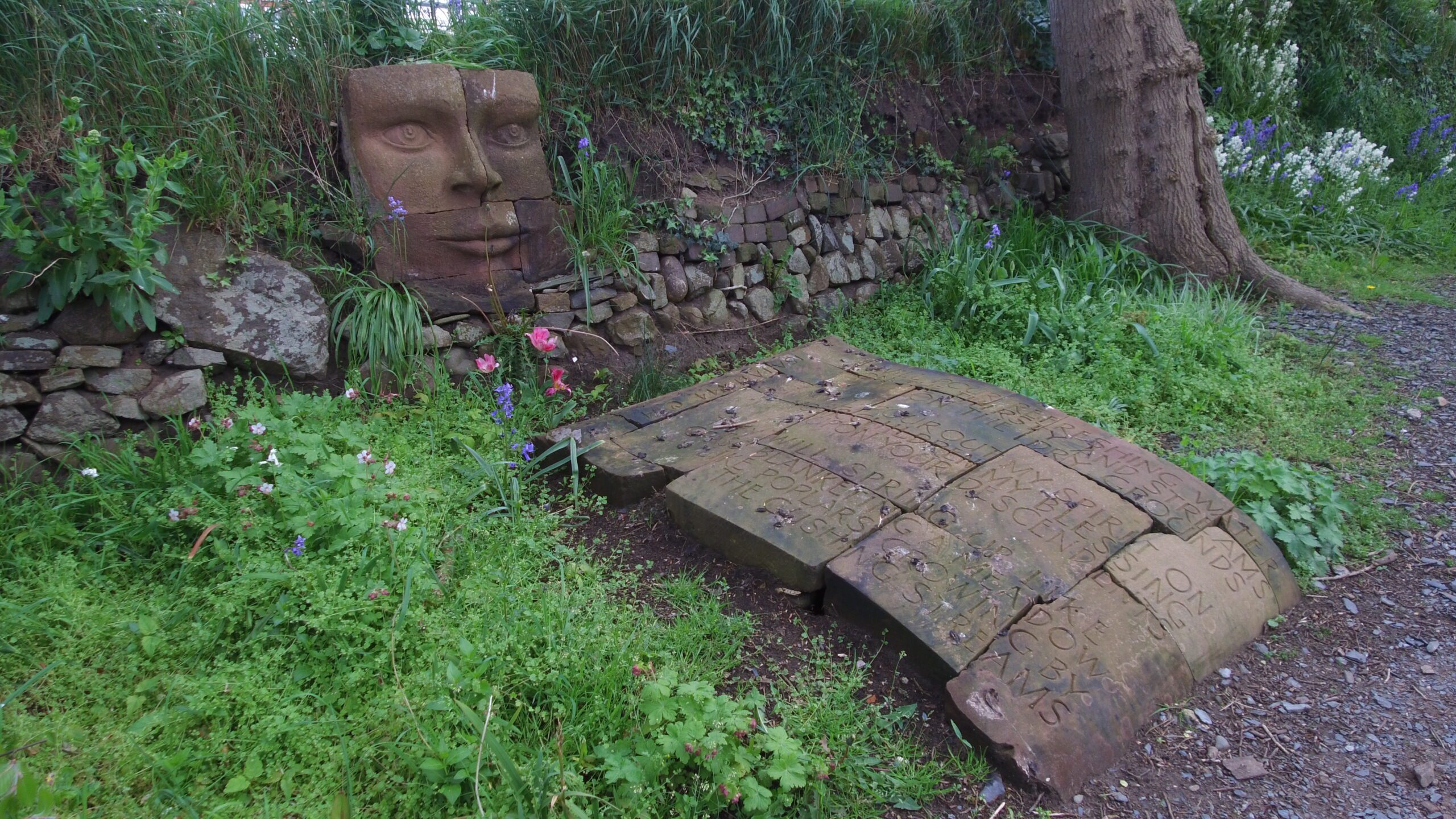
This garden celebrates the Manx language, so plants will be labelled in Latin, English and, where possible Manx. The setting of the gardens is woodland with a canopy of trees overhead which limits the planting material that can be used. The plants are laid out in rows as if text in a bible with the path being the spine of the book. Pages of the Bible emerge from either side of the path with a text from Isaiah 44 verse 3-4 in English (to the east) and in Manx to the west.
I will pour refreshing water
on the thirsty and streams
on the dry grounds I will pour my Spirit on
your children my blessing
upon your descendants They will spring up like
grass blanketing a meadow, like poplars growing by the gushing streams
Son ver-yms magh ushtey
er e honsyn ta paagh,
as thooillaghyn er y
thalloo chirrym;
nee’m my Spyrryd y
gheayrtey magh
er dty luight,
as my vannaght er
cloan dty chlienney:
As aasee ad seose myr maste’yn faiyr,
as myr shellee rish ny coorseyn-ushtey.
The planting scheme is in the pink spectrum; pink symbolizes love and nurturing, and in psychological terms, hope. The garden offers hope for the future of the Manx language and culture. The motto of the Manx Language Society, formed in 1899: ‘Gyn shengey, syn cheer’ (no language, no country) will be inlaid on the path.
Today
Today the Manx language has experienced a revival, being taught in all primary schools and with one school in St John’s (Bunscoill Ghaelgagh) teaching all subjects through the medium of Manx. The translation of the Bible into Manx helped make this possible. 2019 marked the two hundredth anniversary since the Bible was first published in Manx in a single volume. The UN designated 2019 as the Year of Indigenous Languages.