
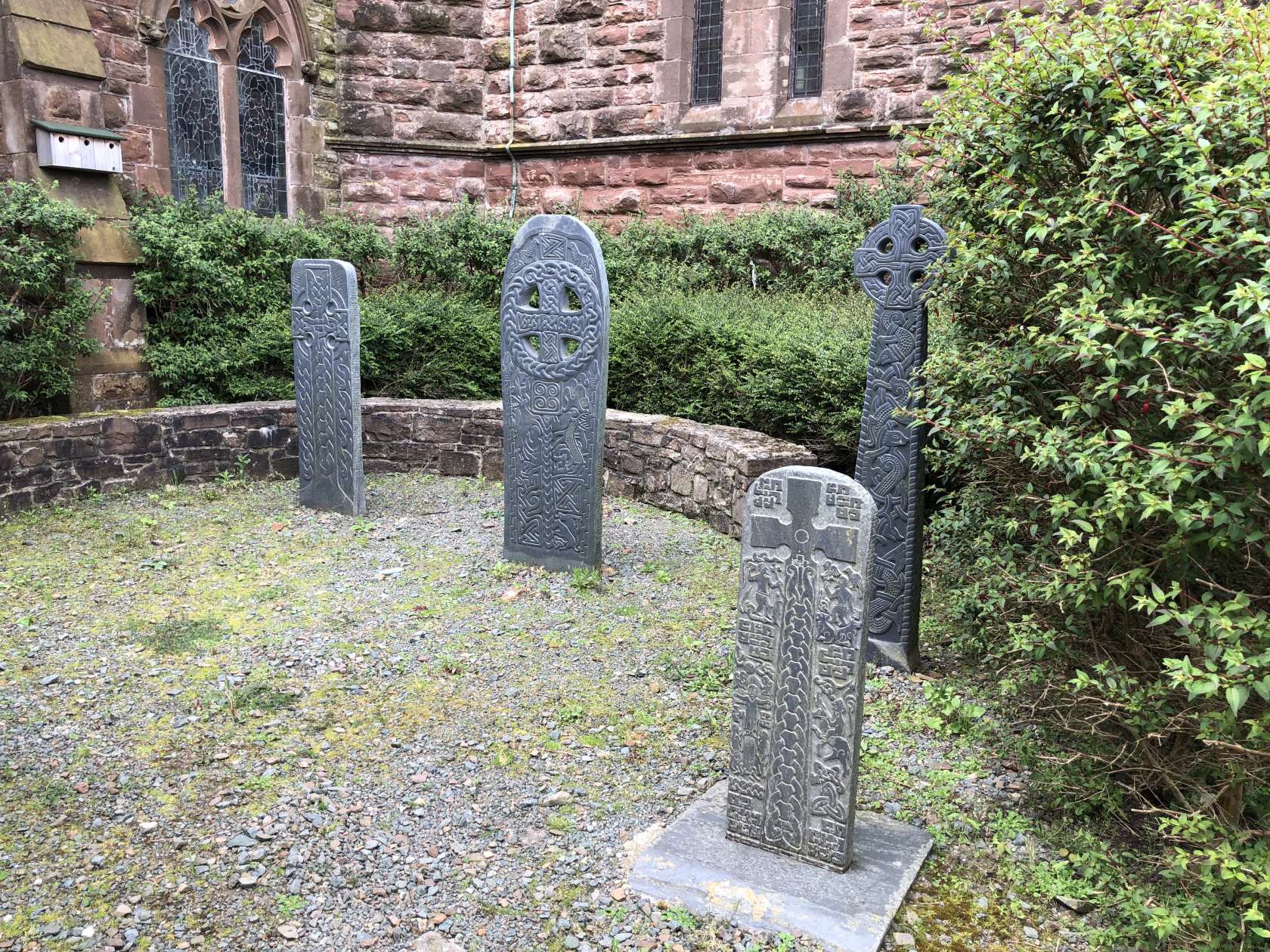
The Cross Garden 10th– 11th century
The History
The Celtic peoples of the Island, from as early as the late 8th century, began to experience Norse invasion and this is reflected in their art. The crosses in this garden reflect the transition as the Norse population began to mingle Nordic myth and Christian symbols. The turbulence of the period is indicated by the number of silver hordes discovered.
The Design
Three circles in this garden will represent the round towers that were characteristic of the period and associated with monasteries, especially in Ireland. A quarter segment of the only Round Tower on the Isle of Man, on St Patrick’s Isle, is built with its doorway high above the ground, possibly for defensive reasons (to the rear of the tower is the herringbone stone pattern also visible on an ancient building on St Patrick’s Isle). The low sandstone wall is topped by a bench that suggests a Norse long ship, the circumference represents the tower at Kilkenny which our diocese is twinned with. The paving has a circle, representing the largest round tower in Ireland, written on it is text from ‘The Chronicles of Man’ that speaks about the Viking invasion. Set in the paving are silver coins representing hoards discovered relating to this period. The Lonicera nitida hedge represents the waves of the sea and the Fuchsia hedge, with its blood red flowers, represents battles such as Sky Hill in 1079.
Dominating the garden are five crosses showing the transition from Celtic to Norse Art (from left to right they are: The Lonan Wheel head cross, Gaut’s Cross, Thor’s Cross, Thorlief Hnakki’s Cross and finally Thorwald’s Cross). In the case of Thorwald’s Cross, only a fragment of the original remains – a Christian holding a fish – this fragment is widely used as symbol by Manx National Heritage. We have sought the best academic advice to re-create the cross to suggest what it might have looked like when complete and in the landscape. Thorwald’s Cross is unique in having the story of Christ on one side and the parallel stories of Thor on the reverse. In the surrounding Isles there is evidence of crosses having been painted and it is assumed they were painted here too, though no traces of pigment remain.
While the Manx crosses were carved from slate, our only round tower is made of red sandstone, unique to Peel. Peel was once famous for herring fishing and kippers. We know that the kippering process was known to the Norse people.
Today
The influence of Celtic design is visible everywhere on the Island; the revival beginning with Archibald Knox in his Art Nouveau/Celtic designs for Liberty of London.