
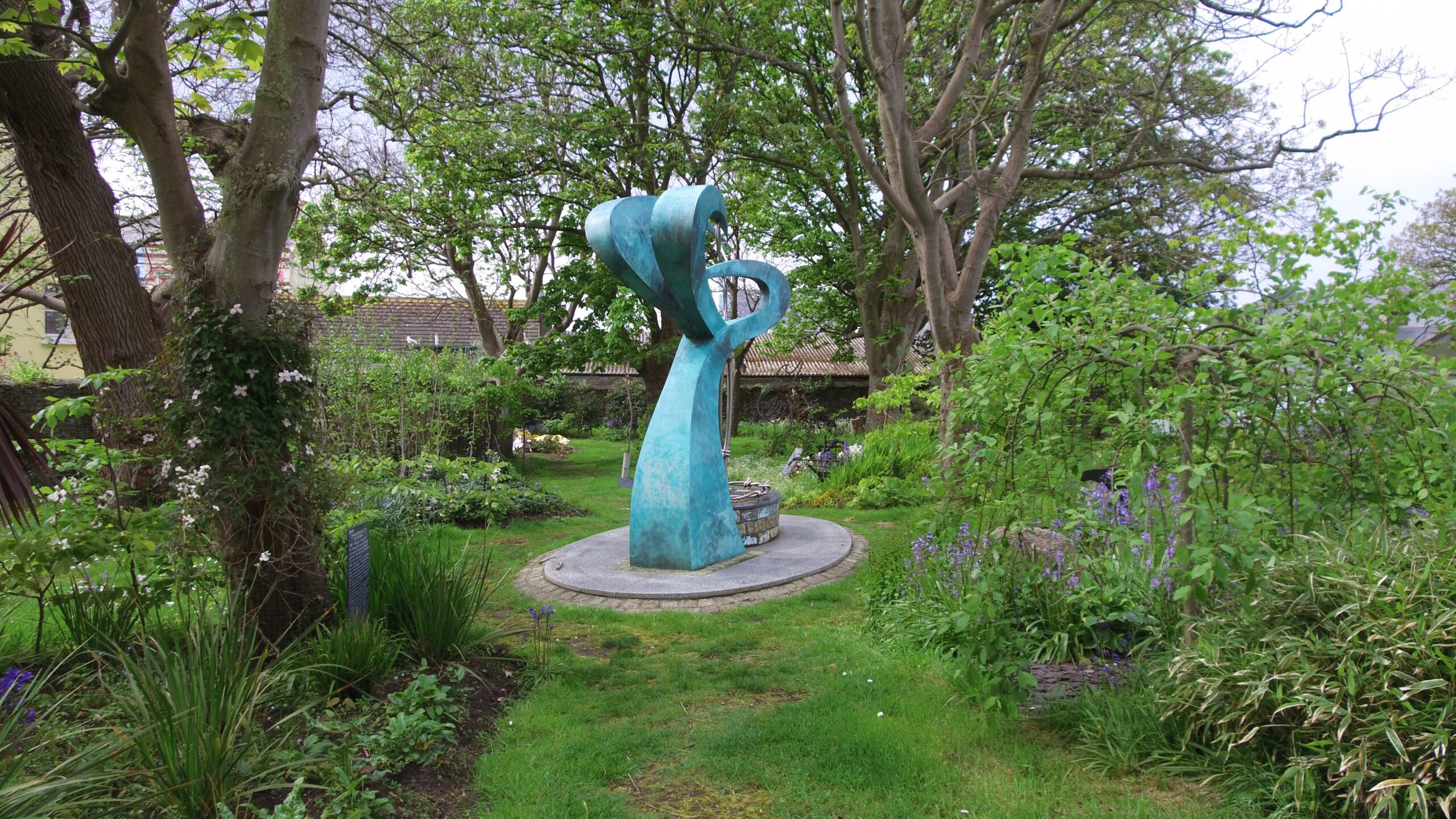
The Knockaloe Garden – 20th Century
The History
The 20th century saw two wars on a global and industrial scale with many technological inventions. Despite this globalisation the world was divided through war and barriers. The Church was forced to come to terms with these wars and especially genocide, with people blaming or abandoning religion. During the World Wars, because of its geographical isolation, the Island became the home of internment camps, with Knockaloe, located a mile south-west of Peel, housing 24,500 people in World War I, (the equivalent of half the then population of the Isle of Man and the largest camp in the British Isles). There was also a smaller camp at Douglas. In World War II boarding houses were used in Douglas, Onchan, Ramsey, Peel and Port Erin for internment and Axis prisoners of War.
The Design
The garden represents the world and its two hemispheres, each of which are divided into north and west, east and south. Between the two hemispheres is an abstract sculpture. The four gardens around this structure represent people coming to Knockaloe as enemy aliens whose backgrounds represented peoples from the four corners of the world. An example of an improbable alien is the story of the Mexican Indian:
‘…there were some very surprising ‘enemy aliens’ amongst us; we were, in fact, quite cosmopolitan. One … bore the name of Schulz-about as common in Germany as that of Smith is in England. … Schulz knew no language except Spanish. He was born in Mexico and looked a full-blooded Mexican Indian, but his name was Schulz, and so he had been arrested on board some ship and brought here.’ Paul Cohn-Portheim
These four gardens also represent genocide in the 20th century in the north, south, east and west. Each of the gardens is based on a fable associated with a genocide. The tree in the middle of one hemisphere is a horse chestnut planted on what would have been Anne Frank’s 80th birthday (she looked out on a chestnut from her hiding place in an attic in Amsterdam). At the centre of the other hemisphere is a concrete post from Knockaloe.
The Knockaloe Garden: Sculpture
Central to this garden is the bronze and stainless steel sculpture by Angela Patchett representing two global figures associated with the Internment camp, Archibald Knox and Josef Pilates. Josef Pilates, an ‘enemy alien’, within the constraints of internment, invented exercises that are now used the world over. Archibald Knox, Celtic-art-nouveau ‘ghost designer’ for Liberty of London and Prior of St. Germain, was a censor at the camp. The sculpture pays homage to these two figures.
The West: The Nazi Holocaust 1938-1945 – 6 million Jewish deaths
Fable: Little Red Riding Hood
The Nazis saw in the fable of Little Red Riding Hood the girl representing the German people being harassed by the wolf, representing the Jewish people. The allies banned the fable immediately after World War II.
The North: The Ukraine Holodomor Forced Famine1932-1933 – 7 million deaths
Fable: Kotyhoroshko
The Kotyhoroshko fable is from the Kiev cycle and was banned by The Soviet Union, who tried to stamp out Ukranian folk traditions.
The Kotyhoroshko fable tells of six sons who go to plough a field and they ask their sister to bring lunch. The sister is told to follow the furrow marks to the field, but a serpent cuts a new furrow leading to his hideout, which led to the capture of the girl. The brothers, searching for their sister, are also captured. Their mother gave birth to another son called Kotyhoroshko. The boy has supernatural strength and sets out to find his brothers and sister. On finding them he overpowers the serpent, but those freed do not recognise their brother and when he is asleep tie him up to steal the serpent’s treasure, they later discover it is their brother.
The South: Rwandan Genocide 1994 – 800,000 deaths
Fable: Sebwgugu and his wife
This fable was told by a 12 year-old boy Ruzigamanzi orphaned by the genocide. He learnt it from his parents.
Where Sebwgugu and his wife lived there was a severe drought. Sebwgugu’s wife, however, found in the wood a thriving pumpkin patch which sustained them. Sebwgugu suggested to his wife that the patch be weeded to improve the crop. She disagreed, however Sebwgugu weeded the patch and the supplies dried up, so she ran away. She stumbled upon a house filled with food and no one at home, so she ate and went to bed. That night a monster appeared asking for help to unload what he was carrying, but instead she locked him out. Next day Sebwgugu found his wife. She told him about the monster and told Sebwgugu not to help him if he returned. The monster returned and ignoring his wife’s warning assisted the monster who ate Sebwgugu. His wife killed the monster with an axe. Then the house owner returned; he had been frightened away by the monster. Impressed by the woman’s beauty and bravery he married her.
The East: Nanjing Massacre 1937-38 300,000 deaths – China generally countless millions
Fable: The Willow Pattern
In the 1790s, Minton (a Stoke on Trent pottery), was inspired by Chinese blue and white porcelain from places like Nanjing and invented the fable of the Willow Pattern.
There was a wealthy Mandarin who had a beautiful daughter (Koong-se) who had fallen in love with her father’s humble accounting assistant (Chang), angering her father. He dismissed the young man and built a high fence around his house to keep the lovers apart. The Mandarin was planning for his daughter to marry a powerful Duke. The Duke arrived by boat to claim his bride, bearing a box of jewels as a gift. The wedding was to take place on the day the blossom fell from the apple tree. On the eve of the daughter’s wedding to the Duke, the young accountant, disguised as a servant, slipped into the palace unnoticed. The lovers escaped to a secluded island.
One day, the Duke learned of their refuge, so he sent soldiers, who burned down their house and they were transformed into a pair of doves.
Today
We recognise that ethnic cleansing continues, so we recall the words of Martin Niemöller:
First they came for the Socialists, and I did not speak out—
Because I was not a Socialist.
Then they came for the Trade Unionists, and I did not speak out—
Because I was not a Trade Unionist.
Then they came for the Jews, and I did not speak out—
Because I was not a Jew.
Then they came for me—
and there was no one left to speak for me.